
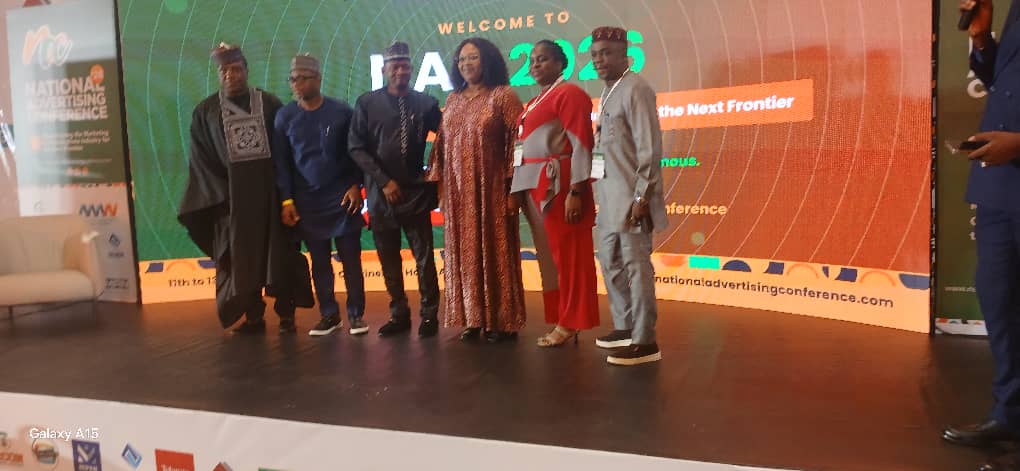
Abuja, Nigeria — Stakeholders across Nigeria’s marketing communications ecosystem, alongside senior federal government officials, regulators, and business executives, have converged in Abuja for the 6th edition of the National Advertising Conference (NAC 2026).
The event, which ran from November 11 to 13, 2026, under the theme “Repositioning the Marketing Communications Industry for the Next Frontier,” examined how artificial intelligence (AI), shifting consumer purchasing power, regulatory reforms, and economic realities are reshaping brand communications in Nigeria.
Delivering the opening address on behalf of the Minister of Information and National Orientation, Alhaji Mohammed Idris, the Permanent Secretary, Dr Binyerem Ukaire, commended the Advertising Regulatory Council of Nigeria (ARCON) for sustaining the annual forum.
The Minister noted that President Bola Ahmed Tinubu’s administration recognises the creative and advertising sector as a vital pillar of national development and has established frameworks to support its expansion.
While acknowledging that AI offers immense enablement for brands, he cautioned that it raises critical questions around authenticity and urged businesses to ensure that consumer data collection strictly respects individual privacy rights.
In his welcome address, ARCON’s Director-General, Dr Olalekan Fadolapo, emphasised that the industry must go beyond passive adaptation to actively anticipate, innovate, and lead in an era defined by AI and digital disruption.
Stressing that technology must remain a tool guided by human insight and ethical standards, Dr Fadolapo highlighted the sector’s substantial macroeconomic footprint.
“A recent study by PwC estimates that for every ₦1 spent on marketing communications in Nigeria, the nation’s GDP increases by a staggering ₦16.50, confirming that our industry has emerged as a formidable economic powerhouse,” Dr Fadolapo stated.
He added that repositioning the sector aligns directly with the Federal Government’s Nigeria First Policy, which prioritises locally produced goods, Nigerian talent, and domestic enterprise.
He also underscored ongoing regulatory reforms, including the 45-day payment threshold, due diligence mandates, local content enforcement, and the operationalisation of the Advertising Offences Tribunal, as essential steps toward building a transparent and accountable market.
Setting the tone for the conference sessions, the Chairman of the NAC 2026 Organising Committee, Mr Tunji Adeyinka, remarked that the next frontier is already transforming how consumers evaluate trust and consume media.
He explained that the conference programme was deliberately structured to tackle difficult industry questions, ranging from broadcast digitisation, audience measurement, and generative AI to the African Continental Free Trade Area (AfCFTA), Gen Z media habits, and the untapped potential of Nigeria’s informal economy.
A high-level panel session moderated by Lampe Omoyele examined Nigeria’s macroeconomic outlook and its direct impact on marketing strategy heading into the 2027 election cycle.
Framing the discussion, the moderator noted key economic indicators, including IMF growth projections of 4.3% against a Federal Government target of 7%, headline inflation at 14.63%, a benchmark interest rate of 23.0%, relative foreign exchange stability, and subdued consumer sentiment.
Contributing to the discussion, a panellist, Olu Akanmu, warned that despite stabilising macroeconomic figures, over 160 million Nigerians, roughly 60% of the population, remain in poverty, keeping prices of goods and services elevated.
He urged marketers to re-engineer their entire marketing mix for value and affordability rather than relying on brand arrogance, while calling on the government to prioritise human capital investments in healthcare and education over prestige infrastructure projects.
Echoing the need for consumer empathy, Adeyinka Jemi-Alade, Group Head of Integrated Marketing Communications at TGI Group, noted that macroeconomic stability has not yet translated into improved household purchasing power, as everyday consumers continue to prioritise basic feeding and substitute higher-priced services for affordable alternatives.
Advising advertisers on budget allocation toward 2027, she stressed the importance of balancing short-term sales with long-term brand building, noting that fostering genuine brand love and clearly communicating product value remain the strongest justifications for sustained marketing investment.
All rights reserved. The content on this website, including text and other digital materials, may not be reproduced, published, broadcast, rewritten, or redistributed in part without the express written consent of The News Accelerator Network.
For advertising inquiries, news coverage, or press releases, please get in touch with us at
📧 thenewsacceleratornetwork@gmail.com